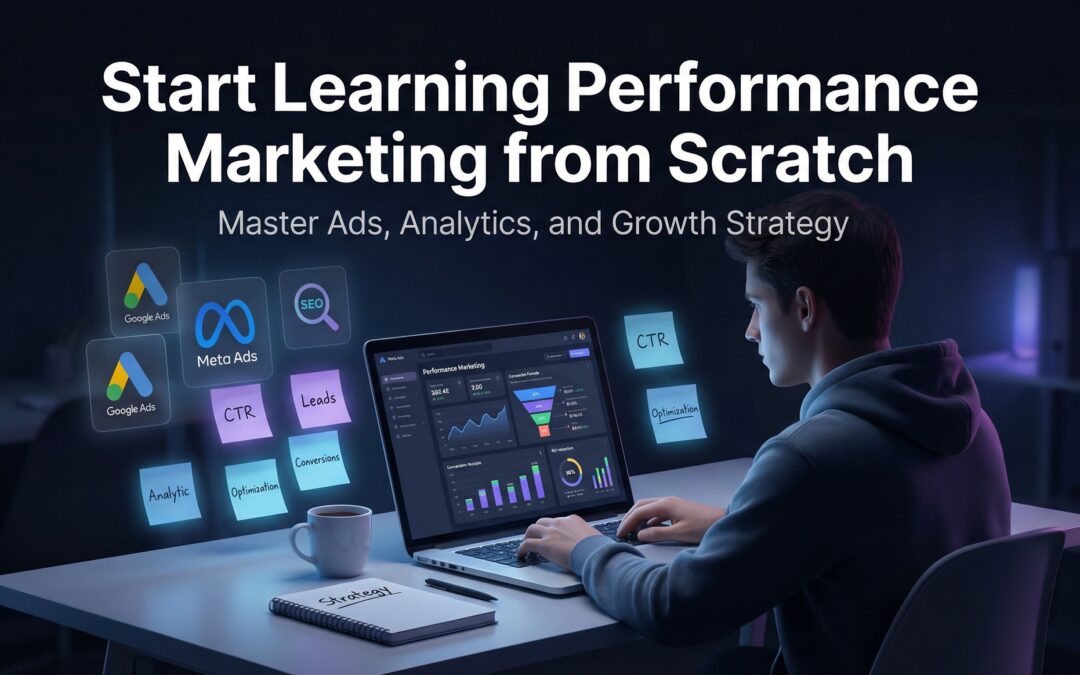
Performance marketing is a type of digital advertising where businesses only pay when a specific action happens—like a sale, a click, or a sign-up. Unlike traditional marketing where you pay upfront and hope for results, performance marketing lets you track every dollar you spend and see exactly what you get back. If you’re looking to start a career in digital marketing or want to grow your business online, learning performance marketing is one of the smartest moves you can make. This guide will walk you through everything you need to know to start from zero, including what to learn, where to practice, and how to get your first results.
Contents
- 1 What Is Performance Marketing and Why Should You Learn It
- 2 The Basic Skills You Need Before Starting
- 3 Understanding the Core Concepts of Performance Marketing
- 4 Choosing Your First Platform to Learn
- 5 Where to Learn Performance Marketing for Free
- 6 Setting Up Your First Practice Campaign
- 7 Learning to Write Effective Ad Copy
- 8 Understanding Analytics and Data
- 9 Common Mistakes Beginners Make
- 10 Building Your Portfolio and Getting Experience
- 11 Next Steps After Mastering the Basics
- 12 Frequently Asked Questions
- 12.1 How long does it take to learn performance marketing?
- 12.2 Do I need money to start learning performance marketing?
- 12.3 Can I learn performance marketing without a website?
- 12.4 What’s the difference between performance marketing and regular marketing?
- 12.5 Which is better to learn first: Facebook Ads or Google Ads?
- 12.6 Can I learn performance marketing on my own or do I need a course?
What Is Performance Marketing and Why Should You Learn It
Performance marketing is result-focused advertising. You set up campaigns on platforms like Google Ads, Facebook, or TikTok, and you only pay when someone takes the action you want. This could be buying a product, downloading an app, filling out a form, or clicking a link.
The biggest reason to learn performance marketing is simple: businesses need it. Every company that sells online needs people who can bring them customers without wasting money. That makes performance marketers valuable and well-paid.
Unlike other marketing skills that take years to master, you can start seeing results with performance marketing in just a few weeks. You can test small campaigns, learn what works, and build your skills with real data instead of theory.
The Basic Skills You Need Before Starting
You don’t need a marketing degree to learn performance marketing, but you do need to understand a few basic concepts first.
Start by learning how the internet works for businesses. Understand what a website is, how people find websites through search engines, and why companies want email addresses or phone numbers from visitors.
You should also get comfortable with numbers. Performance marketing involves looking at data every day. You’ll need to calculate things like cost per click, conversion rate, and return on ad spend. Don’t worry—the math is simple. If you can add, subtract, multiply, and divide, you have enough math skills.
Basic computer skills matter too. You’ll be working with spreadsheets, uploading images, writing ad copy, and switching between different platforms. If you know how to use Google Sheets or Microsoft Excel and can figure out new software by clicking around, you’re ready.
Understanding the Core Concepts of Performance Marketing
Before you start running campaigns, you need to understand how performance marketing actually works.
Every campaign starts with a goal. Do you want people to buy something? Sign up for a newsletter? Download an app? Your goal determines everything else about your campaign.
Next comes targeting. This means choosing who sees your ads. You can target people based on age, location, interests, behavior, and dozens of other factors. Good targeting means your ads reach people who actually want what you’re offering.
Then you create the ad itself. This includes the image or video, the headline, the description, and the link. Your ad needs to grab attention and make people want to click.
When someone clicks your ad, they land on a webpage. This is called a landing page. The landing page needs to convince visitors to take your desired action. If your landing page is confusing or slow, people will leave without doing anything, and you’ll waste money.
Finally, you track everything. Performance marketing platforms give you detailed data about how many people saw your ad, how many clicked, how many took action, and how much each action cost you.
Choosing Your First Platform to Learn
You can’t learn every advertising platform at once, so pick one to start with. Your choice should depend on what kind of products or services you want to promote.
Facebook Ads is the best starting platform for most beginners. The interface is user-friendly, you can start with a small budget (even five dollars a day), and Facebook has billions of users. Facebook Ads also includes Instagram, so you’re learning two platforms at once. This platform works well for e-commerce, local businesses, and almost any consumer product.
Google Ads is the second most popular choice. Google Ads lets you show up when people search for specific keywords. If someone searches “buy running shoes online,” your ad can appear at the top of their results. Google Ads is perfect for businesses where people are actively searching for solutions, like plumbers, lawyers, or online stores.
TikTok Ads is newer but growing fast. If you want to reach younger audiences or create viral video content, TikTok offers huge opportunities. The platform is less crowded than Facebook or Google, which sometimes means cheaper results.
Pick one platform and stick with it until you understand it well. Learning one platform deeply is better than knowing three platforms poorly.
Where to Learn Performance Marketing for Free
You don’t need expensive courses to learn performance marketing. The best education resources are free or very cheap.
Start with YouTube. Channels like Surfside PPC, Ben Heath, and Charlie Morgan post detailed tutorials about running ads on different platforms. Watch videos about setting up campaigns, targeting audiences, and analyzing results.
The advertising platforms themselves offer free training. Facebook Blueprint is Facebook’s official learning platform with courses, videos, and certifications. Google Skillshop does the same for Google Ads. These resources are created by the companies that built the platforms, so the information is accurate and up-to-date.
Blogs and websites also provide valuable information. Websites like Neil Patel, HubSpot, and WordStream publish articles about marketing strategies, case studies, and tips. Reading one good article every day will build your knowledge quickly.
Join free communities on Reddit, Facebook Groups, or Discord. Places like r/PPC or r/digital_marketing let you ask questions and learn from people who are already running campaigns. You can see what problems real marketers face and how they solve them.
Setting Up Your First Practice Campaign
Reading about performance marketing isn’t enough. You need hands-on practice, even if you don’t have a real business yet.
The simplest way to practice is to promote something that already exists. Pick a product on Amazon that you genuinely like and create a practice campaign to promote it. You won’t actually run the campaign (which would cost money), but you’ll go through all the steps of setting it up.
Another option is to offer your services to a small local business for free or cheap. A neighborhood restaurant, gym, or shop probably needs more customers and might let you run a small test campaign. This gives you real experience while helping someone’s business grow.
You can also create a simple product yourself. This could be a free ebook, a list of resources, or a landing page offering advice. Then run a very small campaign (five to ten dollars per day) to promote it. Even if nobody signs up, you’ll learn how campaigns work and see real data.
If you have zero budget, use the platform’s ad simulators or demo accounts. Facebook and Google both offer ways to explore their advertising interfaces without spending money.
Learning to Write Effective Ad Copy
Your ad copy is the text that appears in your advertisements. Good copy makes people stop scrolling and click. Bad copy gets ignored.
The most important part of any ad is the headline. Your headline should clearly state what you’re offering and why someone should care. Instead of “Check out our new product,” try “Save 2 Hours Every Morning with This Simple Tool.”
Keep your sentences short and simple. Each sentence should have one clear idea. Avoid jargon and fancy words. Write like you’re talking to a friend.
Focus on benefits, not features. A feature is what something is or does. A benefit is how it makes life better. “Waterproof jacket” is a feature. “Stay dry even in heavy rain” is a benefit. People buy benefits.
Always include a clear call to action. Tell people exactly what you want them to do: “Shop Now,” “Learn More,” “Get Your Free Trial,” or “Download the Guide.” Don’t make them guess.
Test different versions of your copy. Write three different headlines and see which one gets more clicks. Change one thing at a time so you know what made the difference.
Understanding Analytics and Data
Performance marketing runs on data. Every campaign generates numbers that tell you what’s working and what isn’t.
The most basic metric is impressions. This tells you how many times your ad was shown. If you have very few impressions, your targeting might be too narrow or your budget too small.
Click-through rate (CTR) shows what percentage of people who saw your ad actually clicked it. If 1,000 people saw your ad and 20 clicked, your CTR is 2%. A higher CTR usually means your ad is interesting and relevant.
Cost per click (CPC) tells you how much you pay each time someone clicks your ad. Lower is better. If you spent fifty dollars and got 100 clicks, your CPC is fifty cents.
Conversion rate is the percentage of clickers who completed your desired action. If 100 people visited your landing page and 5 bought your product, your conversion rate is 5%.
Return on ad spend (ROAS) is the most important metric for businesses. It shows how much money you made for every dollar you spent. If you spent one hundred dollars on ads and made three hundred dollars in sales, your ROAS is 3:1.
Start tracking these numbers from day one. Keep a simple spreadsheet where you write down your results. Over time, you’ll see patterns and learn what numbers are good or bad.
Common Mistakes Beginners Make
New performance marketers often make the same mistakes. Learning what not to do will save you time and money.
The biggest mistake is giving up too quickly. Most campaigns don’t work perfectly on the first try. You need to test different audiences, different ad copy, different images, and different landing pages. Success comes from testing and improving, not from getting lucky on the first attempt.
Another mistake is targeting too broadly. Showing your ad to everyone sounds like a good idea, but it wastes money. Instead, target a specific group of people who are most likely to want what you’re offering. You can always expand later.
Beginners also ignore their landing pages. You can have the perfect ad, but if your landing page is slow, confusing, or doesn’t match what the ad promised, people will leave. Make sure your landing page is simple, fast, and clearly explains what you’re offering.
Many new marketers also spend too much too fast. Start with a small daily budget and increase it only after you prove your campaign works. Running a two hundred dollar campaign before you know what you’re doing is a expensive way to learn.
Finally, don’t copy other ads blindly. Just because you see an ad running doesn’t mean it’s profitable. That company might be losing money or testing something new. Trust your own data more than other people’s ads.
Building Your Portfolio and Getting Experience
Once you understand the basics, you need proof that you can deliver results. A portfolio shows potential clients or employers what you can do.
Start by documenting every campaign you run, even practice ones. Take screenshots of your ad setup, your results, and any improvements you made. Write a simple case study that explains what you did and what happened.
Offer to run campaigns for friends or small businesses at a discount or for free. Even a small local business can give you real experience and a testimonial you can use later.
Create content that shows your knowledge. Start a simple blog or LinkedIn profile where you share what you’re learning. Write posts about mistakes you made, lessons you learned, or interesting trends you notice. This builds credibility and helps people find you.
Consider getting certified. Facebook Blueprint and Google Skillshop both offer free certifications. While certificates don’t replace experience, they do show you took the time to learn properly.
As you gain experience, ask clients for testimonials and permission to share results. A testimonial that says “Sarah increased our sales by 40% in two months” is powerful proof of your skills.
Next Steps After Mastering the Basics
Once you’re comfortable running campaigns on one platform, it’s time to expand your skills.
Learn a second advertising platform. If you started with Facebook, try Google Ads next. Each platform teaches you something different, and businesses often want marketers who can handle multiple channels.
Study conversion optimization. This means learning how to improve landing pages, write better product descriptions, and design checkout flows that convert more visitors into customers. The best ads in the world won’t work if your landing page is terrible.
Explore email marketing. Many performance marketers collect email addresses through their campaigns and then use email to nurture those leads into customers. Tools like Mailchimp or ConvertKit are free to start with.
Learn basic design skills. You don’t need to become a professional designer, but knowing how to create simple graphics in Canva or edit photos will make your ads better and save you money.
Stay updated on changes. Advertising platforms change their rules and features constantly. Follow industry blogs, subscribe to newsletters, and join communities where people discuss updates.
Frequently Asked Questions
How long does it take to learn performance marketing?
You can understand the basics in about four to six weeks if you study a little every day. However, becoming skilled enough to run profitable campaigns consistently usually takes three to six months of practice with real campaigns. The learning never really stops because platforms and strategies keep changing.
Do I need money to start learning performance marketing?
You can learn the theory and setup process without spending money by using free resources and platform demos. However, to gain real experience, you’ll eventually need to run actual campaigns. You can start with as little as five to ten dollars per day, which means a monthly budget of one hundred fifty to three hundred dollars is enough for meaningful practice.
Can I learn performance marketing without a website?
Yes. Many platforms let you send traffic directly to product pages, app downloads, or lead forms without needing your own website. However, having a simple landing page usually improves results. You can build free landing pages using tools like Carrd, Google Sites, or Mailchimp.
What’s the difference between performance marketing and regular marketing?
Regular marketing often focuses on building brand awareness and doesn’t always measure specific actions. Performance marketing focuses only on measurable results like sales, sign-ups, or downloads, and you only pay when those actions happen. Performance marketing is more direct and data-focused.
Which is better to learn first: Facebook Ads or Google Ads?
Facebook Ads is usually easier for beginners because the interface is simpler and you can target people based on interests and behaviors. Google Ads requires understanding keywords and search intent, which can be more complex. However, if you’re in an industry where people actively search for solutions (like home services or B2B), Google Ads might be more relevant to start with.
Can I learn performance marketing on my own or do I need a course?
You can absolutely learn on your own using free resources like YouTube, platform documentation, and blogs. Paid courses can speed up learning by organizing information, but they’re not necessary. The most important thing is hands-on practice, which you must do yourself regardless of whether you take a course.
Such an usefull content helped me a lot thank you
I appreciate your feedback. Happy to know the content helped you